REVIEW · BAYEUX
DDay American Beaches and US Airborne Full Day Tour from Bayeux
Book on Viator →Operated by HQ Company Tour · Bookable on Viator
Six hours of walking thoughts, not just miles.
This full-day Bayeux tour turns the Normandy landings into a route you can actually follow, starting with Omaha Beach and ending at a church aid station in Angoville-au-Plain. I like that the pacing is built for understanding, not for speed, and that the guide keeps bringing it back to what soldiers faced in real time.
Two things I especially liked: the small group of max 7 means you’re not shouting over noise, and you get time to ask questions when something on the maps or terrain doesn’t click yet. I also love the mix of stops: the beaches, the Normandy American Cemetery, and the airborne story in Sainte-Mère-Eglise all reinforce each other.
One drawback to plan around: it’s a long day (about 8 hours 30 minutes), and since lunch isn’t included, you’ll want to eat before you start or bring a simple option so you don’t get grumpy halfway through the coast.
In This Review
- Key highlights that matter in real life
- Entering the D-Day story from central Bayeux, with time for questions
- Omaha Beach: how the terrain explains the pain
- The Normandy American Cemetery at Colleville-sur-Mer: quiet, grounded, worth the stop
- Pointe du Hoc: the Ranger story written into the cliffs
- Sainte-Mère-Eglise: the airborne operation in a church-town
- Utah Beach: the 4th Infantry Division and Theodore Roosevelt Jr.
- Angoville-au-Plain church aid station: the quiet, moving end
- Timing, comfort, and how to pace yourself on an 8.5-hour day
- Price and value: what you pay for (and what you don’t)
- Who should book this US Airborne and American Beaches day
- Should you book? My practical take
- FAQ
- How long is the D-Day American Beaches and US Airborne full day tour from Bayeux?
- Where does the tour start and what time?
- What’s the maximum group size?
- Is the tour in English?
- What’s included in the price?
- Is lunch included?
- Are admission tickets included for the stops?
- What sites are visited during the day?
- What if the weather is bad?
Key highlights that matter in real life
- Max 7 travelers: more back-and-forth with guides like Sophie, Yannick, Chloe, and Michael (many guests praised the question-friendly pace).
- Round-trip from central Bayeux in an A/C minivan: you avoid the stress of parking and self-driving.
- Free admissions at the listed stops: Omaha, the American Cemetery, Pointe du Hoc, Sainte-Mère-Eglise, Utah Beach, and Angoville-au-Plain.
- US-only lens on D-Day: Omaha and Utah plus the Ranger and Airborne angles.
- A moving ending at Angoville-au-Plain, tied to medics treating wounded soldiers for two days.
- Guides using maps and pictures at each site: multiple reviews singled out how visual aids made the terrain make sense.
Entering the D-Day story from central Bayeux, with time for questions
This is the kind of Normandy day trip that feels manageable because the logistics are handled for you. You start at Place du Québec in Bayeux at 9:00am, then you’re on the road with a driver and an experienced, certified English-speaking guide. With a group capped at 7, it’s not a cattle-car museum run. You can ask, stop the flow, and get answers without feeling like you’re holding everyone up.
The minivan is an underrated part of the value. If you’re coming from Bayeux (or you’ll be using Bayeux as your base), this route saves you from the two big time-wasters: finding parking and figuring out how to connect the sites in a sensible order. Several guests explicitly said it was a relief not to drive yourself, and at least one noted how their guide helped when parking went sideways.
What you’re really buying here is interpretation. The guides use handheld maps, pictures, and story-based explanations so you can connect the dots between beach terrain, cliff lines, and where units moved afterward. If you’ve ever stared at a coastline and thought, Okay… where do I even start, this tour is designed to solve that problem fast.
You can also read our reviews of more tours and experiences in Bayeux.
Omaha Beach: how the terrain explains the pain
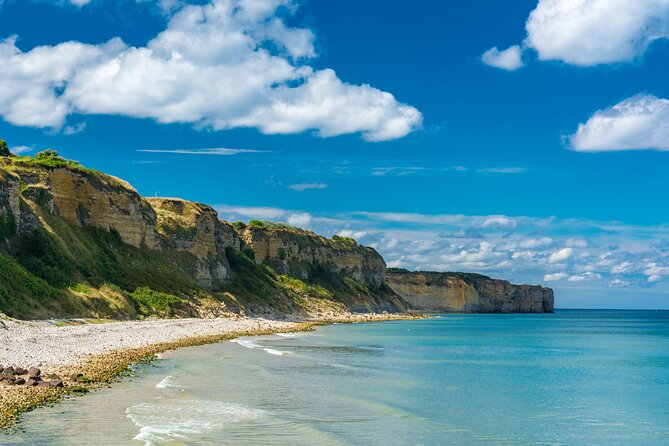
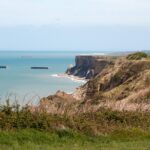
The day begins at Omaha Beach, with a short drive from Bayeux and then a focused look at where the 1st and 29th US Infantry Divisions landed. You don’t just get a viewpoint and a few facts. You get a guided walk through the layout of the German defenses and what the first waves were dealing with—an approach that helps you understand why Omaha is remembered as brutally difficult.
Practically, you have about 40 minutes at Omaha. That’s enough time for the guide to orient you, point out key terrain features, and explain the situation using maps and images. It also gives you a chance to step back and take in the scale of the shoreline. Standing there after hearing how the defenses were positioned changes the way you read the beach. You start noticing how the geography would have shaped movement, vulnerability, and timing.
A small-group format helps here too. When questions come up—about unit actions, why certain positions mattered, or how attackers tried to adapt—your guide can answer without rushing you. Reviews praised guides for balancing overview with detail, and for keeping a respectful tone. This is history you should approach with care, and the tour’s structure supports that.
Tip for your comfort: bring layers. The coast can be breezy, and you’ll be outdoors at at least a few stops.
The Normandy American Cemetery at Colleville-sur-Mer: quiet, grounded, worth the stop
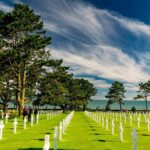
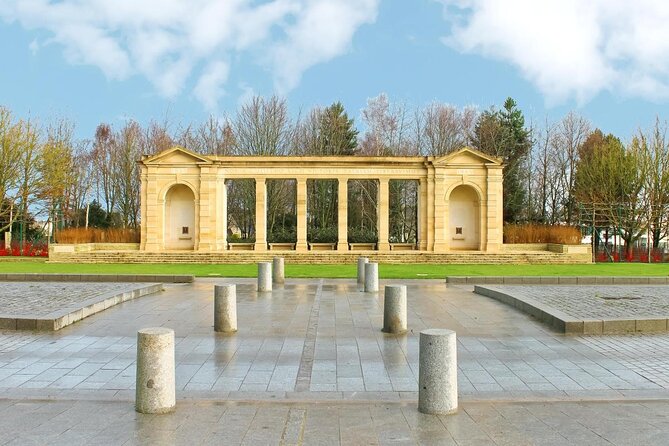
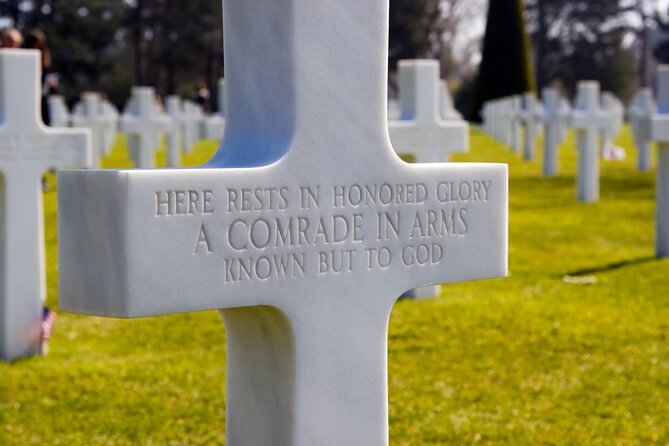
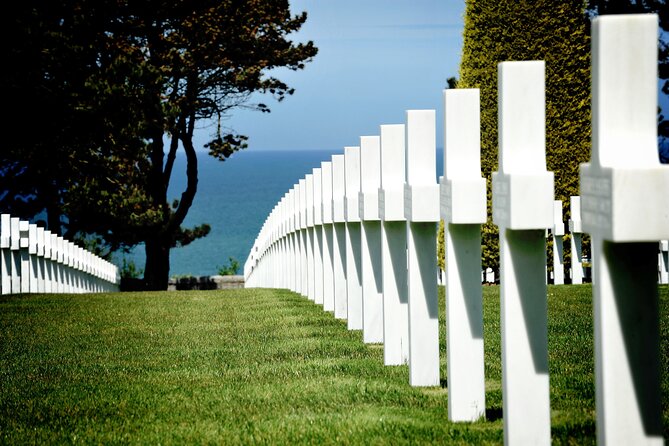
Next comes the American cemetery behind Omaha Beach at Colleville-sur-Mer. This stop is about more than sight-seeing. You’ll learn what the cemetery represents and visit a resting place for more than 9,000 American servicemen and women, run by the American Battle Monuments Commission.
You’re given about 1 hour, and that time is important. Cemeteries don’t reward rushing. With a guide present, you also avoid the common problem of wandering without context. The tour gives you the background you need so the place hits harder in the right way—less like a checklist stop, more like a remembrance stop with meaning.
This cemetery is often described as the most visited D-Day site in Normandy, and you can see why once you’re there. Even if you’re not a “cemetery person,” you’ll likely find the experience emotionally direct. Several guests called it visually compelling and moving, and more than one mentioned it as a top highlight.
If you want to make the experience personal: if you have family names you’d like to search for, give yourself extra attention during your hour there. (The tour provides the guided frame, but you can still slow down for the details that matter to you.)
Pointe du Hoc: the Ranger story written into the cliffs
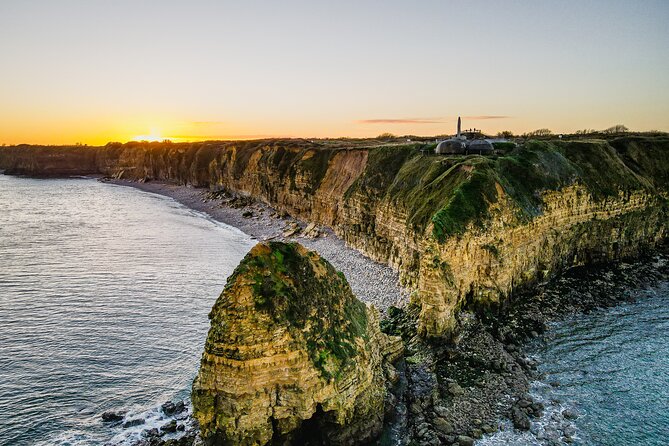
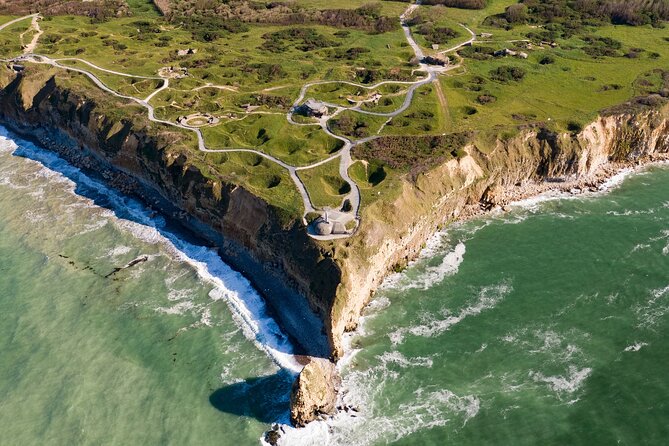
After the cemetery, the route shifts to Pointe du Hoc, famous for the mission led by the 2nd US Ranger Battalion under Lieutenant Colonel James E. Rudder. This stop is where the day starts feeling like a thriller—except the stakes are life-and-death, and the landscape is scarred in a way you can still see.
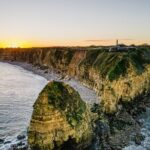
The guide explains how the Rangers scaled the cliffs to destroy a German gun battery that threatened the overall landing operation. You’ll see bomb craters, bunkers, and dugouts—physical reminders that the battle wasn’t theoretical. It happened right here, with very real obstacles and exposure.
You have about 1 hour at Pointe du Hoc. That’s a good length because it lets you absorb what you’re seeing before you’re transported to the next town. If you’re the type who likes pictures and maps (and judging by how often guests praised the visual aids, most people are), this is one of the best stops for that style of guiding.
One caution: this is a “look and think” site, not a quick photo stop. If you rush, you miss what makes Pointe du Hoc such a powerful part of the D-Day narrative.
Sainte-Mère-Eglise: the airborne operation in a church-town
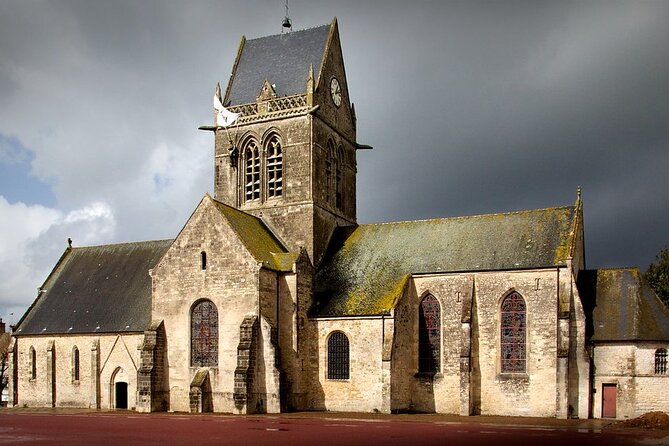
From Pointe du Hoc, it’s about a 30-minute drive to Sainte-Mère-Eglise, at the heart of the Airborne story. This is the first town captured by American paratroopers, and the guide connects the event to what you can see today—especially the famous image of a paratrooper getting stuck in the church tower.
You’ll spend around 1 hour in the town area. This is the stop where the tour earns points for turning big operations into human stories. Guides often talk about the nighttime chaos, the targets, and the way airborne troops had to improvise as events unfolded.
Also, Sainte-Mère-Eglise is where several guests specifically highlighted the museum option in their favorite list. If your schedule allows, this is a smart moment to decide whether you want more context indoors versus staying focused on the town’s key sites. The guide’s maps and stories will help either way, and a good guide will point out what to look for so you’re not just browsing.
What makes this stop valuable is that it prevents “beach-only history.” Normandy isn’t just a sea landing. The airborne drops shaped the early fight, and Sainte-Mère-Eglise makes that idea click.

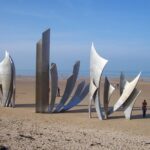
Utah Beach: the 4th Infantry Division and Theodore Roosevelt Jr.
Next you head about 20 minutes to Utah Beach. This is where the narrative balances out Omaha’s difficulty with an account of how the 4th Infantry Division successfully breached German defenses.
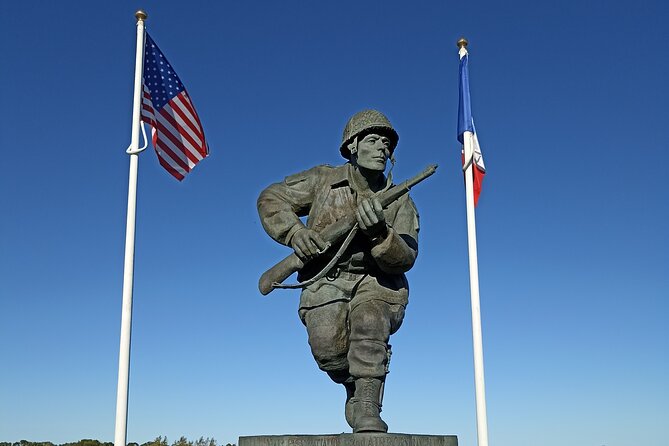
You’ll have about 2 hours here, which is generous compared to many one-day itineraries. The guide explains the landing timeline, including the moment when the first wave was led by Brigadier General Theodore Roosevelt Jr., landing at 6:30am. You’ll also hear about his Medal of Honor, which helps frame why the day is remembered not just as tactics, but as leadership under brutal conditions.
Why the time matters: Utah Beach offers space to orient yourself. With enough time, you can connect what you’ve learned at previous stops—defenses, unit movement, terrain—and watch the whole operation form a picture rather than a list.
If you came to Normandy expecting to see “big water and guns,” Utah delivers more than that. It’s a chance to understand how different beaches played different roles in one campaign.
Angoville-au-Plain church aid station: the quiet, moving end
After Utah Beach, you drive about 15 minutes to Angoville-au-Plain, where the group visits the church used as an aid-station. This stop is one of the most emotionally grounded parts of the day because it focuses on what it meant to treat wounded soldiers when help was limited and time was short.
The guide explains how two young medics treated about 80 wounded soldiers for two days. And crucial detail: the story in the tour description isn’t limited to one side. It emphasizes shared humanity during the fighting. That’s a tone shift from gun batteries and cliff missions, and it lands with weight.
You’ll have about 45 minutes at this final site, then you head back to Bayeux. Several guests described this ending as excellent and moving—exactly the kind of closure you want after spending the day witnessing the operation’s scale.
If you’re tired (it happens), this is still a stop where your attention will pay off. It gives meaning to the day beyond strategy.
Timing, comfort, and how to pace yourself on an 8.5-hour day
This tour runs about 8 hours 30 minutes total. That’s long enough that you need to think about comfort, not just interest. Here’s what helps you enjoy it more:
- Plan for lots of standing and walking at outdoor battlefield stops. You’re going to want shoes you can stand in for stretches.
- Eat before the tour. Lunch isn’t included, and you don’t want to be negotiating with your own hunger while listening to stories.
- Bring a light layer. Even if the day looks warm, coastal winds and changing conditions are common in Normandy.
Also, while the stops have scheduled times, the real rhythm depends on your group and your guide’s style. The tour’s format is built so the guide can give you context before you look, then answer questions after you’ve seen the terrain. The small-group size makes it easier to follow.
Price and value: what you pay for (and what you don’t)
At $169.31 per person, you’re not paying for a generic bus ride. You’re paying for three things that are hard to replicate on your own:
- Interpretation at each site
This route is set up to teach you how the battlefield works, not just where it is.
- Transportation with reduced stress
Round-trip from central Bayeux in an A/C minivan matters on a long day. You don’t have to figure out parking or the best order of sites.
- A small group that encourages questions
With a maximum of 7 travelers, the guide can slow down when you need clarity.
Admission tickets at the listed stops are marked as free, which also helps your budget. The one major item not included is lunch, so your total cost will depend on what you choose to eat.
In other words: the price feels fair when you value a guided, US-focused D-Day storyline with transportation and time to actually absorb it.
Who should book this US Airborne and American Beaches day
I think this tour fits best if you’re in one of these situations:
- You want a US-centered D-Day overview without building your own driving route.
- You like maps and visuals, not just speeches. Many guides are praised for using pictures and handheld materials at each stop.
- You’ll enjoy learning in a small group where questions are welcomed.
- You’re staying in or near Bayeux and want one strong day devoted to the American story.
If you already know a lot and want hours inside museums at every stop, you might find the outdoor time limits your depth. But if you want your first Normandy campaign picture to be clear and meaningful, this is a solid place to start.
Should you book? My practical take
Book it if you want a first-rate way to see the American D-Day story from Omaha to Utah, with the Airborne angle woven in. The biggest selling point for me is the combination of small group + guided interpretation. It turns scattered places into an understandable operation.
Skip or consider a different option if you’re traveling with very limited mobility or you hate long days with standing outdoors. Also, if you’re coming with an empty stomach problem waiting to happen, plan food early since lunch isn’t included.
If you do book: pick comfortable shoes, plan a snack or meal for later in the day, and come with one or two questions you’d love answered. With guides like Sophie, Yannick, Chloe, Michael, and Gwen mentioned in guest experiences, you’re likely to get thoughtful, respectful answers—not just facts on the fly.
FAQ
How long is the D-Day American Beaches and US Airborne full day tour from Bayeux?
The tour runs about 8 hours 30 minutes.
Where does the tour start and what time?
It starts at Place du Québec in Bayeux, with a 9:00am start time. It ends back at the meeting point.
What’s the maximum group size?
The tour has a maximum of 7 travelers.
Is the tour in English?
Yes, the tour is offered in English.
What’s included in the price?
It includes round-trip transportation from central Bayeux in an A/C minivan and an experienced, certified guide.
Is lunch included?
No, lunch is not included.
Are admission tickets included for the stops?
Admission tickets are listed as free for the stops described in the itinerary.
What sites are visited during the day?
You visit Omaha Beach, the American cemetery at Colleville-sur-Mer, Pointe du Hoc, Sainte-Mère-Eglise, Utah Beach, and Angoville-au-Plain.
What if the weather is bad?
The tour requires good weather. If it’s canceled due to poor weather, you’ll be offered a different date or a full refund.