REVIEW · BAYEUX
Normandy – Utah, Omaha & U.S. D-Day Sites Full Day Tour From Bayeux
Book on Viator →Operated by Ophorus · Bookable on Viator
D-Day hits different when you stand there. I love the small group size (up to 19), which makes it easy to ask questions and actually hear answers, and I like the air-conditioned van with onboard Wi-Fi that keeps the day moving comfortably. One thing to consider: it’s an 8-hour circuit, so you’re in motion a lot and you won’t get the slow, wander-at-will pace.
This is the kind of tour that turns place names into a timeline. You’ll connect the U.S. airborne story at Sainte-Mère-Eglise with the landing stories at Utah Beach and Omaha Beach, and you’ll ground it all with a stop at the Normandy American Cemetery in Bayeux. If you catch the guides people rave about—Pascal, Vic, Valentine, Matt, Luana, Maggie, John, or Killian—you’ll get explanations that make the coastline make sense, not just look impressive.
The main drawback isn’t the sites. It’s the emotional weight and the schedule. If you want lots of museum-style sitting down, or you’re the type who needs long breaks between stops, you may feel slightly rushed. Still, for most first-timers, it’s a smart way to see the core locations in one day.
In This Review
- Key Things You’ll Be Glad You Did
- Why This Bayeux D-Day Day Tour Works in One Long Day
- Starting in Bayeux: Place du Québec and Getting Your Bearings
- Sainte-Mère-Eglise: The Village That Explains the Jump-Zone Story
- Utah Beach: The Landing Area You Can Actually Imagine
- Pointe du Hoc Walk: Vertical Cliffs, Rangers, and a Real-World Schedule Change
- Lunch Near Pointe du Hoc: Use the Hour Smartly
- Normandy American Cemetery in Bayeux: The Stop That Changes the Volume
- Omaha Beach at the End: Finishing with Context
- Price and Value: Is $168.95 Worth It?
- Comfort, Timing, and Small-Group Logistics (Without the Stress)
- Who This Tour Suits Best
- Should You Book This Tour?
- FAQ
- How long is the Normandy – Utah, Omaha & U.S. D-Day Sites full day tour from Bayeux?
- What’s the group size limit?
- What language is the tour offered in?
- What sites are included during the day?
- Is Pointe du Hoc included?
- Does the tour include transport and Wi-Fi?
- Are meals included?
- What happens if the weather is poor or the tour can’t operate?
Key Things You’ll Be Glad You Did
Small group (max 19) for real conversation: fewer people means the guide can respond to your questions.
Air-conditioned minivan with Wi-Fi: helpful for keeping your maps straight and staying comfortable.
Guided battlefield route: you’ll visit multiple D-Day-related sites rather than just one beach.
Cemetery stop that lands hard: the Normandy American Cemetery visit is timed as a meaningful pause.
Pointe du Hoc update starting Jan 2, 2026: closure means Pointe du Hoc is replaced with La Cambe German War Cemetery.
Lunch window near Pointe du Hoc: one focused hour to eat without derailing the full schedule.
Why This Bayeux D-Day Day Tour Works in One Long Day
You don’t come to Normandy to scroll photos. You come to understand what happened—where, and why that terrain mattered. This full-day format is built for that, hitting several major U.S.-connected D-Day points plus a cemetery stop that gives the story a human scale.
The value here is not just transport. It’s interpretation. The guided stops help you connect what you see on the ground with the tactics, the geography, and the chaos of June 1944—without turning the day into a lecture marathon.
Yes, it’s a lot of driving, and yes, you’ll feel it by hour seven. But the payoff is that you finish the day with a clear mental map, not a pile of unrelated battlefield facts.
You can also read our reviews of more tours and experiences in Bayeux.


Starting in Bayeux: Place du Québec and Getting Your Bearings
The tour begins at Place du Québec in Bayeux at 9:00 am, and you’ll spend about half an hour there first. This short start matters more than it sounds like. It’s your moment to get oriented, meet your English-speaking guide/driver, and settle into the day’s rhythm.
Bayeux is also a useful base because it keeps things simple. You’re not hopping around multiple towns for pickups. The meeting point is near public transportation, and the tour ends back at the same spot, so you’re not left guessing how to get home after a long day out on the sites.
If you’re sensitive to long days, arrive a few minutes early and take care of basics before you meet the group. Once you’re in “battlefield mode,” it’s not the time to hunt for a snack.
Sainte-Mère-Eglise: The Village That Explains the Jump-Zone Story
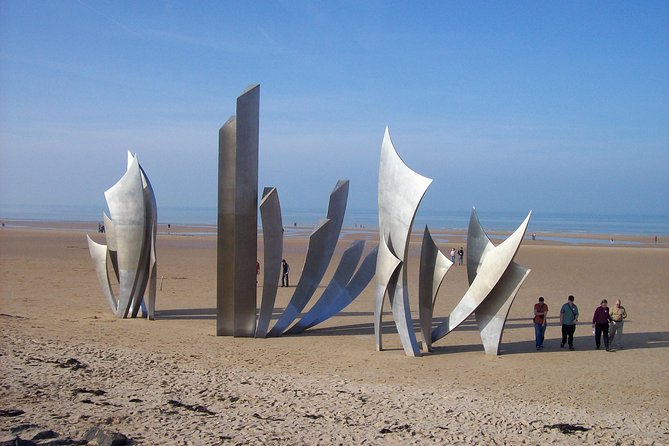
Sainte-Mère-Eglise is where the U.S. airborne narrative comes into focus, and the tour gives you 1 hour 30 minutes there. You’re in the heart of the jump zone for the 82nd Airborne U.S. forces, so the guide can point out what the town and surrounding area meant during the drop and early fighting.
This stop often hits hardest if you remember that paratroopers didn’t just “land.” They landed into uncertainty: at night, under fire, with scattered groups trying to regroup. Walking around a village tied to that story helps you understand why timing and terrain were so critical.
It’s also the stop that tends to set the emotional tone. You’re not yet on the wide beaches, but you’re already in the middle of the invasion’s most chaotic early hours.
Utah Beach: The Landing Area You Can Actually Imagine
You’ll spend about 1 hour 30 minutes at Utah Beach, and the entry ticket for the stop is included. Utah is sometimes less famous than Omaha, but it’s the kind of place where the guide’s framing helps you see why multiple landing sectors were part of a bigger plan.
When you stand there, you can’t help thinking about distance. Even without walking far, the scale of the shoreline and the defenses give you that “okay, this is real” feeling. The guide helps you move beyond the headline story into what soldiers faced the moment they hit the water and tried to push inland.
Practical tip: this is one of the places where you’ll want sturdy shoes. You may be walking on uneven ground near viewpoints, and you’ll be glad you’re not doing it in soft sneakers.
Pointe du Hoc Walk: Vertical Cliffs, Rangers, and a Real-World Schedule Change
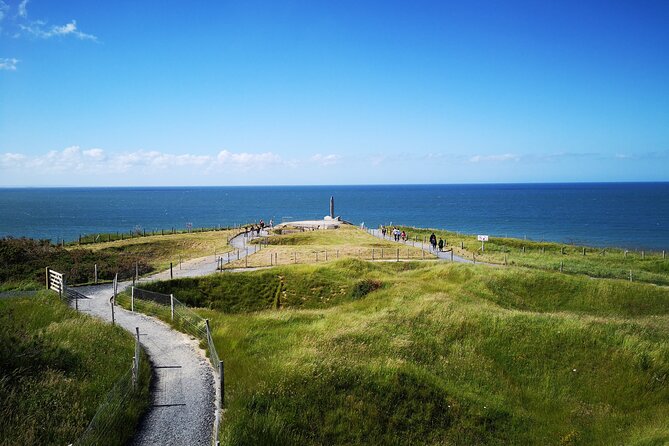
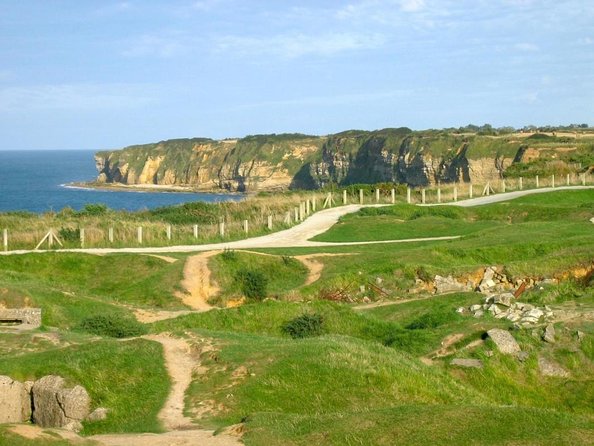
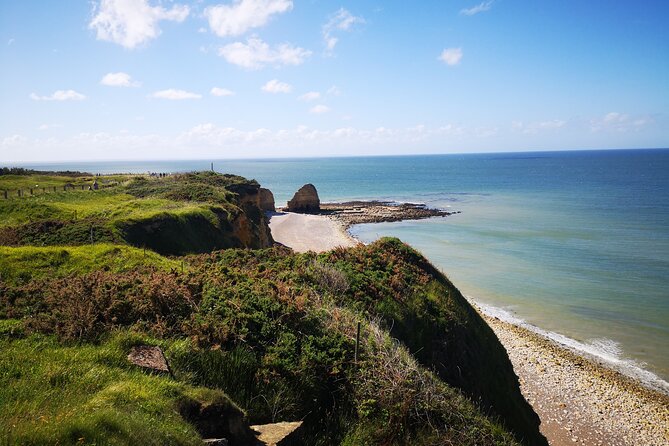
Pointe du Hoc is built for the wow factor. The tour includes a walk there and a guided focus on how U.S. rangers scaled a vertical cliff—about 1 hour for the site.
Important update: As of January 2nd, 2026, Pointe du Hoc is no longer included due to site closure for renovation work. It will be replaced by a visit to La Cambe German War Cemetery. If you’re traveling after that date, expect a different final “shock-and-awe” moment—more cemetery and reflection, less cliff-scaling history.
Even with that change, the story still comes through. You’ll be placed in a setting that forces you to think about the lengths both sides went to control that stretch of coast. If you’re the kind of traveler who likes seeing the terrain explain the tactics, this is one of the stops you’ll remember most.


Lunch Near Pointe du Hoc: Use the Hour Smartly
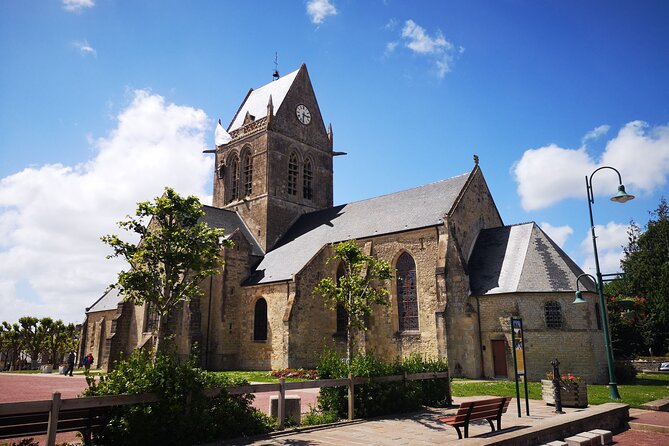
After the Pointe du Hoc time, you get about 1 hour of free time for lunch near the area. The tour’s schedule assumes you’ll eat without losing the pace of the day.
This is where I’d be practical: keep your meal simple and quick. You don’t want a long sit-down that turns the rest of your stops into a sprint. If you’re visiting in warmer months, this also helps you avoid the “sun + walking + long lunch” combo that can knock the energy out of you.
If you want to keep the battlefield story fresh, use the lunch break to ask one last question or two. Guides often have smart recommendations on what to look for next—especially for how Omaha’s setting differs from Utah.
Normandy American Cemetery in Bayeux: The Stop That Changes the Volume
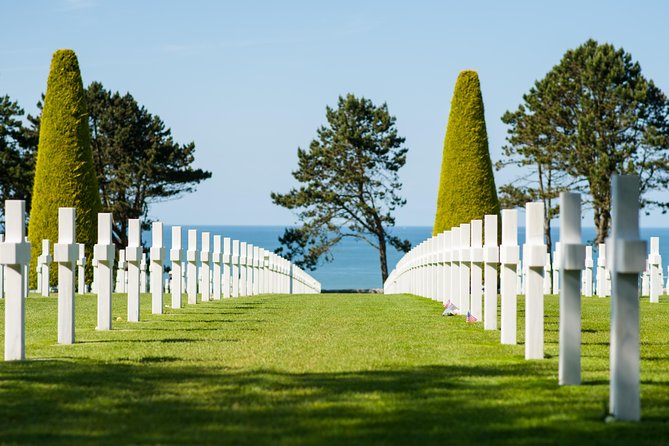
You’ll visit the Normandy American Cemetery in Bayeux for about 1 hour. This is one of those places where being “just slightly tired” is not enough—because the site asks for quiet attention whether you’re ready or not.
The cemetery connects the story to the cost. You’re not only looking at coastline and strategy. You’re looking at the names of young men and women who didn’t come home. Guides can add context, but even without extra explanations, the setting speaks.
If your timing lines up, you may also be present for the cemetery’s flag lowering and taps. That kind of ceremony can hit like a wave—brief, formal, and very human.
Practical note: bring a layer. Cemeteries can feel cooler or windier than the surrounding towns, and it’s not fun to be cold while you’re trying to focus.
Omaha Beach at the End: Finishing with Context
Omaha Beach is your final major battlefield stop, with about 1 hour there. It’s a powerful close because by this point you’ve already built the mental map: airborne chaos at the jump-zone village, landing-area realities at Utah, the cliff defenses at Pointe du Hoc (or the cemetery replacement after Jan 2, 2026), and the cemetery emotional grounding.
Omaha works especially well after you’ve heard the timeline out loud. The guide can help you interpret what you’re seeing in layers: defenses, approach, and what it meant to push inland after the first landings.
If you can, linger for a few extra minutes at the viewpoint. Don’t spend the full hour checking your phone. Let the scene sit in your mind for a bit, then let the guide’s last explanations settle it.
Price and Value: Is $168.95 Worth It?
At $168.95 per person for an 8-hour day, you’re paying for three things: a professional English-speaking driver/guide, air-conditioned transportation (max 19 people), and guided access that’s structured so you can see multiple sites without spending the day figuring out logistics.
What helps the value here is that some key elements are built in. Utah Beach and Pointe du Hoc have admission tickets listed as included, and the other stops are marked as free admission. You’ll also get mobile tickets and a Wi-Fi-equipped van, which sounds small until you’ve spent a day hopping between locations.
What’s not included is important: meals and drinks are not provided, and entrance fees to monuments, museums, and attractions are listed as not included. So think of the tour as the guided battlefield route plus the transportation and (some) site entry—great for interpretation, not a full-day all-inclusive meal package.
If you’re traveling with someone who wants to read everything and someone who just wants to see the places, this format can satisfy both, as long as your group is okay with a structured schedule.
Comfort, Timing, and Small-Group Logistics (Without the Stress)
This tour runs from 9:00 am and lasts about 8 hours. It’s designed to fit a full day without dragging you into late-night logistics. Since it’s a minivan with onboard Wi-Fi and air-conditioning, it’s much easier to stay calm when the itinerary packs in multiple stops.
The max group size is 19, which is the difference between hearing the guide and losing the thread. In smaller groups, you’ll often get more personal attention—especially if you show interest by asking straightforward questions like what a specific position was used for, or what soldiers were trying to accomplish at that moment.
Weather matters. The tour is listed as requiring good weather, and if it’s canceled due to poor weather, you’ll be offered another date or a full refund. That’s a big deal for Normandy, where rain and wind can change how comfortable the walking feels.
Also, there’s a small operational detail to keep in mind: the tour requires 2 adults to operate. If you’re traveling solo, you’ll want to check your departure date carefully when you book.
Who This Tour Suits Best
This is a strong pick if you:
- want a guided battlefield day with multiple U.S.-connected stops
- like small groups where you can ask questions
- prefer to learn the “why” behind the scenery instead of just taking pictures
It may not be ideal if you:
- hate long driving days
- want lots of museum time or big freeform wandering
- need extra time at memorials beyond the allotted stops
Families should note there’s a restriction: children under 4 aren’t allowed, and pets aren’t allowed.
Should You Book This Tour?
I think this tour is worth booking if you’re short on time in Normandy and want a guided, coherent story across the key U.S. D-Day sites. The small group size and the emotionally grounded cemetery stop make it feel more like a day with a thoughtful guide than a rushed checklist.
Be sure to check the Pointe du Hoc situation for your travel date. If you’re going after January 2nd, 2026, you should expect La Cambe German War Cemetery to replace Pointe du Hoc due to closure.
If you like asking questions, this is your sweet spot. Go prepared with a couple of topics you care about (airborne drop chaos, landing defenses, ranger mission goals), and you’ll leave with a map in your head that actually holds together.
FAQ
How long is the Normandy – Utah, Omaha & U.S. D-Day Sites full day tour from Bayeux?
It runs for approximately 8 hours, starting at 9:00 am and returning to the meeting point in Bayeux.
What’s the group size limit?
The tour has a maximum of 19 travelers.
What language is the tour offered in?
The tour is offered in English.
What sites are included during the day?
You’ll visit Sainte-Mère-Eglise, Utah Beach, Pointe du Hoc (when included), the Bayeux American Cemetery (Normandy American Cemetery), and Omaha Beach.
Is Pointe du Hoc included?
Pointe du Hoc is scheduled in the tour, but as of January 2nd, 2026 it will no longer be included due to closure for renovation and will be replaced by a visit to La Cambe German War Cemetery.
Does the tour include transport and Wi-Fi?
Yes. You travel by air-conditioned vehicle (max 19 people) and there is Wi-Fi onboard.
Are meals included?
No. Meals and drinks are not included. There is a free time lunch period near Pointe du Hoc.
What happens if the weather is poor or the tour can’t operate?
The experience requires good weather. If it’s canceled due to poor weather, you’ll be offered a different date or a full refund. The tour also requires a minimum number of travelers to operate; if that minimum isn’t met, you’ll be offered a different date/experience or a full refund. The experience is non-refundable and cannot be changed once booked.