REVIEW · PARIS
Pointe du Hoc,Omaha Beach, American Cemetery – Day trip from Paris to Normandy
Book on Viator →Operated by ADRIAN ROADS · Bookable on Viator
Normandy hits different when you see the terrain up close. This small-group day trip from Paris lets you pair Pointe du Hoc and Omaha Beach with museum time and the American Cemetery, all with a guide who ties locations to what happened on D-Day. The early start also means you spend less of your day lost to logistics and more of it standing where history played out.
Two things I especially like: the max small group size (up to 7 people) keeps the pace human, and the trip includes admission to the Overlord Museum so the story has real context instead of just monuments. One heads-up: it’s a very long day (about 13 to 14 hours), and without lunch included, you’ll want to plan your food strategy before the day gets away from you.
In This Review
- Key highlights that make this day trip worth it
- A very long day with a real payoff: Paris to Normandy, 6:30am start
- Pointe du Hoc: the cliffs, the guns, and the 100-foot punchline
- The National Guard Monument at WN72: honoring the break-through point
- Omaha Beach: Easy Green monuments and why photo stops still matter
- The 1st US Infantry Division monument and WN62 Resistance Nest
- Overlord Museum at Omaha Beach: where reconstructions make sense
- Colleville-sur-Mer American Cemetery: the place you remember for life
- Arromanches Mulberry harbour remnants: victory built on shipping math
- Price and value: what $326.53 buys for a full Normandy day
- Timing, comfort, and tips to keep the day from dragging
- Should you book this Paris to Normandy WWII day trip?
- FAQ
- How long is the Paris to Normandy day trip?
- What time does the tour start in Paris?
- Where does the tour meet and where does it end?
- Is the tour in English?
- What’s included in the price?
- Can I cancel for a full refund?
Key highlights that make this day trip worth it
- Up to 7 people means more time for questions and fewer “bus-tour” bottlenecks
- Pointe du Hoc gives you the Atlantic Wall story from the cliffs—artillery bunkers, craters, and scale
- Omaha Beach sectors are more than photo stops, with named sites tied to the landing plan
- Overlord Museum admission included helps you connect vehicles, personal items, and the broader timeline
- Colleville-sur-Mer American Cemetery covers the full emotional arc with the Walls of the Missing
- Arromanches Mulberry harbour remnants show the invasion wasn’t just fighting—it was logistics
A very long day with a real payoff: Paris to Normandy, 6:30am start
If you only have one day to do Normandy from Paris, this kind of trip works because it compresses a big geographic area into one route. You start early (6:30am), and the driving time is a big part of your day—plan on being “out” for roughly 13 to 14 hours total.
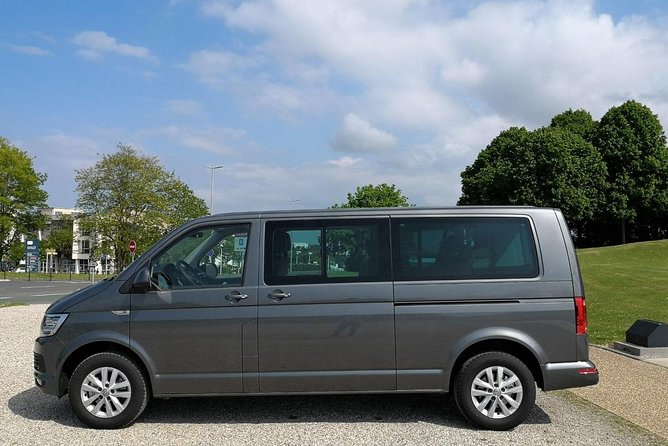
What makes it workable is the setup: you’re in an air-conditioned vehicle, with an experienced driver-guide, and the itinerary is structured so you’re not constantly re-planning. That matters on a day where weather can turn, ground can be slippery, and the scale of the coastline can trick your brain into thinking you’re closer to things than you actually are.
You’ll also want to come prepared for standing and walking at several WWII sites. There’s a lot of “pause and look” time in the schedule, but you’re still outside for key stretches, and layers beat heroics.
You can also read our reviews of more tours and experiences in Paris.


Pointe du Hoc: the cliffs, the guns, and the 100-foot punchline
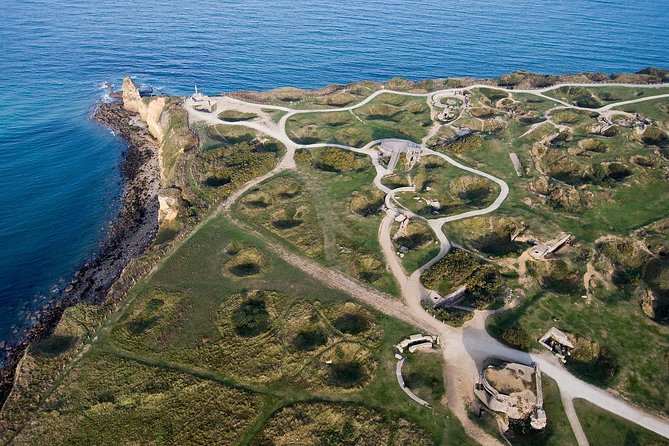
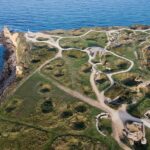
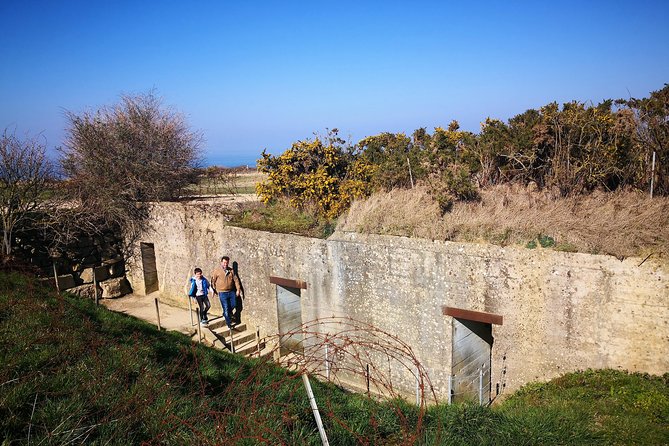
Stop number one is Pointe du Hoc, a place you’ll understand fast once you see it. These are 100-foot cliffs between Omaha and Utah beaches, and the Germans built major defenses right above the shore—concrete bunkers and artillery positions meant to batter any landing forces that came close.
Here’s the story you’ll hear as you stand there: in mid-1943, the German TODD organization set up six long-range 155mm artillery guns, protected inside concrete. The broader context is the Atlantic Wall, the huge coastal defense network meant to stop an Allied landing across Western Europe.
Then comes the D-Day moment. On June 6, 1944 at 07h10am, 225 US Rangers landed just below the cliffs and scaled them using ropes to attack the gun emplacement. The point wasn’t just to destroy equipment. It was to neutralize a critical threat before Allied forces could move inland. Even now, you’ll see traces of the battle—concrete blown apart, bomb craters, and scars in the landscape.
Practical tip: dress for cold and wind, even if Paris feels mild that morning. Pointe du Hoc is exposed, and time spent staring up and down the cliff line is time your body feels the weather. If it sleets or rains, expect the ground to be slick.
The National Guard Monument at WN72: honoring the break-through point
After you’ve absorbed Pointe du Hoc’s dramatic “cliff story,” the tour shifts to a more specific battlefield location: the National Guard Monument. It marks the spot on D-Day where the 29th National Guard Division broke through German defenses (WN72).
This isn’t a massive museum stop. It’s more like a grounding moment. The monument sits atop the original bunker preserved by the local organization that maintains the site, with the intent to honor the National Guardsmen who fought in the European theater.
What I like about including this stop is that it fills in one of the gaps many people have when they only think of the landing as a single “event.” Normandy was made of many smaller breakthroughs, pauses, and hard decisions happening simultaneously along a long coastline. A stop like WN72 helps your brain map that reality.
Omaha Beach: Easy Green monuments and why photo stops still matter
Next you’ll reach Omaha Beach, and the itinerary focuses on a set of monuments in the Easy Green sector. Two memorials are your main photo stops, and both work best when you take a minute to read them instead of just snapping and moving on.
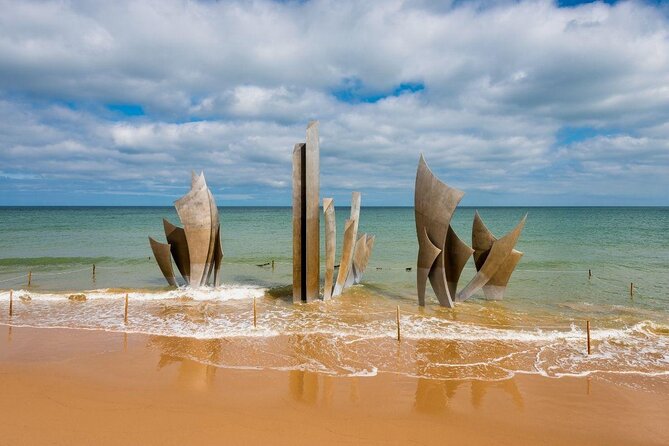
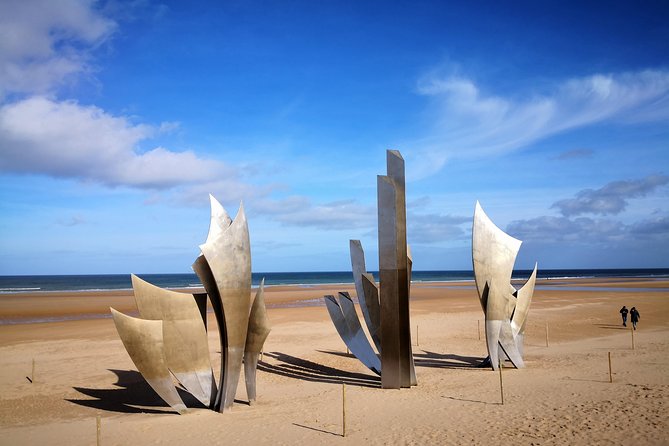
First is the Signal of the Liberation monument. It commemorates the Allied landing on June 6, 1944 and the liberation of Europe. It also has two frescoes on either side—one tied to the 1st US Infantry Division, the other to the 116th Regimental Combat Team of the 29th US Infantry Division. That division-level detail matters because it connects the coastline to the specific units fighting there.
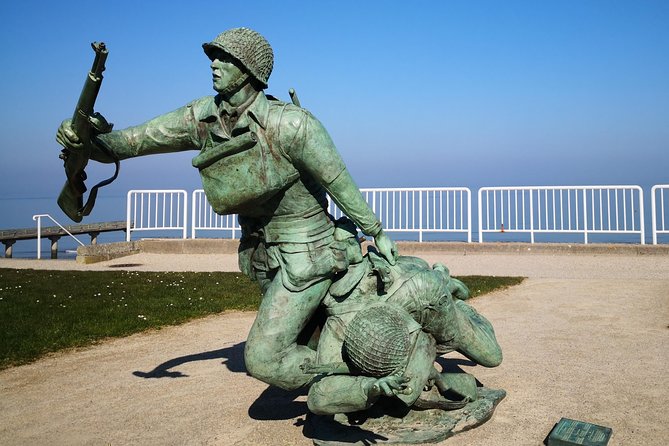
Second is The Braves, a monumental sculptural tribute by Anilore Banon. This one tends to hit people quietly. It doesn’t explain history the way a museum panel does. It forces you to slow down and just look at the idea of courage in stone.
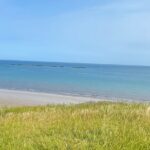
Timing-wise, you’ll get time to walk along the beach. If you want to collect a small souvenir of sand, plan to do it thoughtfully. Use a container you bring, or ask your guide if there’s an approach they recommend. And please keep it respectful—this is still a burial-adjacent, sacred landscape.
The 1st US Infantry Division monument and WN62 Resistance Nest
From the broader Omaha Beach area, the tour takes you to the Memorial of the 1st US Infantry Division (Red Sector / Easy). The key detail here is that the obelisk stands in the middle of WN62, known as Widerstandsnest 62—or Resistance Nest 62.
Why that matters: WN62 was described as one of the strongest defending positions on the Omaha coastline. So when you stand there, you’re not just looking at a monument. You’re looking at the “why it was so hard” part of the story—defended ground, interlocking resistance, and the reality that the landing wasn’t met everywhere by the same level of resistance.
You’ll also get the benefit of understanding how the view lines connect to the larger map. From the position overlooking Easy Red and Fox Green sectors, you start to see why a fixed coastline creates such chaotic, complicated movement during a landing.




Overlord Museum at Omaha Beach: where reconstructions make sense
Once you’re emotionally and geographically oriented, the schedule includes a museum stop: Overlord Museum. Admission is included, and you’ll get about an hour.
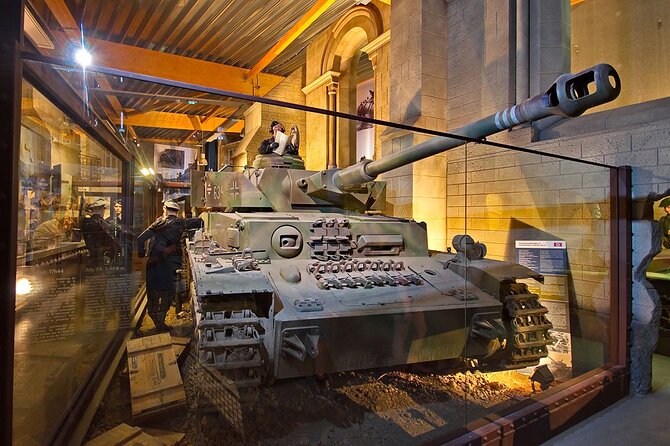
This museum’s value is that it doesn’t just repeat the headline story. It connects the landing period to a broader timeline: from the Allied landing through the liberation of Paris. The collection includes personal items from individual soldiers and displays of armored fighting vehicles from six armies in Normandy.
What I like about this museum, from a practical perspective, is that it’s built as reconstructions with real objects and vehicle information—there are displays showing over 35 vehicles, tanks, and guns. That’s the kind of detail that makes your later “site reading” click when you’re outside again. A bunker is one thing. A bunker attached to a specific unit and piece of equipment is something else entirely.
Colleville-sur-Mer American Cemetery: the place you remember for life
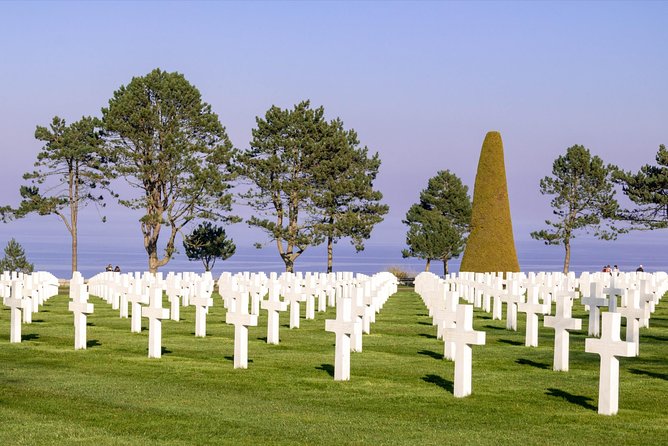
This is the emotional centerpiece: Cimetiere Americain de Colleville-sur-Mer. The American cemetery sits near Omaha Beach and overlooks it, which means you’re not just viewing graves—you’re viewing the coastline the soldiers came to fight for.
The site spans 180 acres and contains 9,387 white crosses, perfectly aligned. There’s also a memorial chapel that adds to the sense of ceremony and reflection. Your guide will share stories of soldiers linked to the area and mention the highest military decorations awarded for gallantry.
On the Walls of the Missing, a semicircular garden on the east side, are 1,557 names. Rosettes mark which names are for those since recovered and identified. The scale of that wall gives you a different kind of understanding: it’s not only about who was buried here—it’s about the uncertainty that lasted after the fighting stopped.
The memorial layout also helps you orient. There’s a semicircular colonnade with loggia spaces holding maps and narratives of operations. At the center is the bronze statue Spirit of American Youth Rising from the Waves. An orientation table overlooks the beach landings, and granite statues represent the United States and France.
Practical tip: go in wearing the right mindset. If you feel like you need “time alone,” build it in. This is one of those places where rushing steals meaning.
Arromanches Mulberry harbour remnants: victory built on shipping math
After the cemetery, the tour shifts gears to a different but equally important Normandy story: logistics. You’ll visit the vestiges of the Mulberry harbour at Arromanches.
Arromanches is remembered as a key landing spot where the Allies installed an artificial port right after D-Day. The aim was simple: get supplies and heavy equipment ashore without waiting for deep-water ports. This artificial harbour allowed about 9,000 tons of material per day to be disembarked.
The British built the system using huge floating concrete caissons, towed from England and assembled into walls and piers. The harbor components formed the Mulberry harbour using pontoons linked to land by floating roadways.
You’ll get a short stop here (about 20 minutes), but the point is the visual reminder. Even today, you can still see sections of the Mulberry harbour—huge concrete blocks sitting on the sand, and more visible farther out at sea.
The key figures your guide will likely reference give the invasion a measurable feel: by 12 June 1944, the Allies had landed 300,000+ men, 54,000 vehicles, and 104,000 tons of supplies. That’s the “how it worked” piece many people miss when they focus only on the fighting.
Price and value: what $326.53 buys for a full Normandy day
At $326.53 per person, this tour isn’t cheap. But for Normandy from Paris, you’re paying for a very specific package: one long day, multiple major WWII sites, and guided interpretation that helps you connect each spot to the bigger battle plan.
You also get real comfort value. The itinerary is done in an air-conditioned vehicle, and the tour is built as a small group (max 7). That’s not just about comfort—it’s about time. On a day like this, time saved from navigation and figuring out logistics is time you can spend standing where the story happened.
The included admission also matters. You’re paying for Overlord Museum admission as part of the package, and the rest of the major exterior sites on the route are listed with free admission. Add it up and the price becomes less about “tickets” and more about “guided access + vehicle + interpretation.”
If you’re deciding between self-driving and a guided day trip, ask yourself what you want most: a scenic drive with loose structure, or a tight route that turns history into something you can actually follow.
Timing, comfort, and tips to keep the day from dragging
This is the kind of trip where small choices matter. A few practical things I’d do before you leave Paris:
- Wear layers. Normandy mornings can feel colder than you expect, and you’ll be outside at exposed sites like Pointe du Hoc.
- Bring a rain jacket. Bad weather can still happen, and the itinerary keeps moving through conditions unless a cancellation occurs.
- Plan lunch on your terms. Lunch and drinks aren’t included. If you’re the type who gets cranky when hungry, bring water and keep food simple.
- Use the guide for orientation. You’ll get location context like sectors (Easy Green, Red Sector / Easy), resistance nest numbers (WN62), and unit connections. Don’t just listen—ask one question when something clicks.
- Give yourself permission to feel it at the cemetery. This isn’t a “sightseeing block” stop. It’s a reflection stop.
One more practical note: your day is structured around early departure and a long return to Paris. Build in a relaxed evening after you get back. Your feet and your brain will need it.
Should you book this Paris to Normandy WWII day trip?
Book it if you want a one-day Normandy hit that covers the big emotional and strategic sites without wasting time. This route gives you the full arc: defenses at Pointe du Hoc, the landing reality at Omaha Beach, the human cost at Colleville-sur-Mer, and the planning and supply story at Arromanches.
Skip it (or look for an alternative schedule) if you want a slower pace, lots of free time in each town, or you hate long travel days. At roughly 13 to 14 hours, it’s a commitment.
One smart move: if your booking can assign or request a guide and Regis is mentioned as an option, it’s worth asking. The tour’s strongest element in the feedback is that the guide’s explanations turn the sites into a clear narrative instead of disconnected monuments.
FAQ
How long is the Paris to Normandy day trip?
The duration is about 13 to 14 hours.
What time does the tour start in Paris?
The start time is 6:30am.
Where does the tour meet and where does it end?
It meets at Théâtre du Lido, 116 bis Av. des Champs-Élysées, 75008 Paris, France, and ends back at the meeting point.
Is the tour in English?
Yes, it’s offered in English.
What’s included in the price?
The package includes an air-conditioned vehicle, a driver-guide, and admission tickets to Overlord Museum.
Can I cancel for a full refund?
Yes. You can cancel up to 24 hours in advance for a full refund. If you cancel less than 24 hours before the start time, the amount paid won’t be refunded.